Sample report · text blurred on purpose
A sample MarkerView report, page by page.
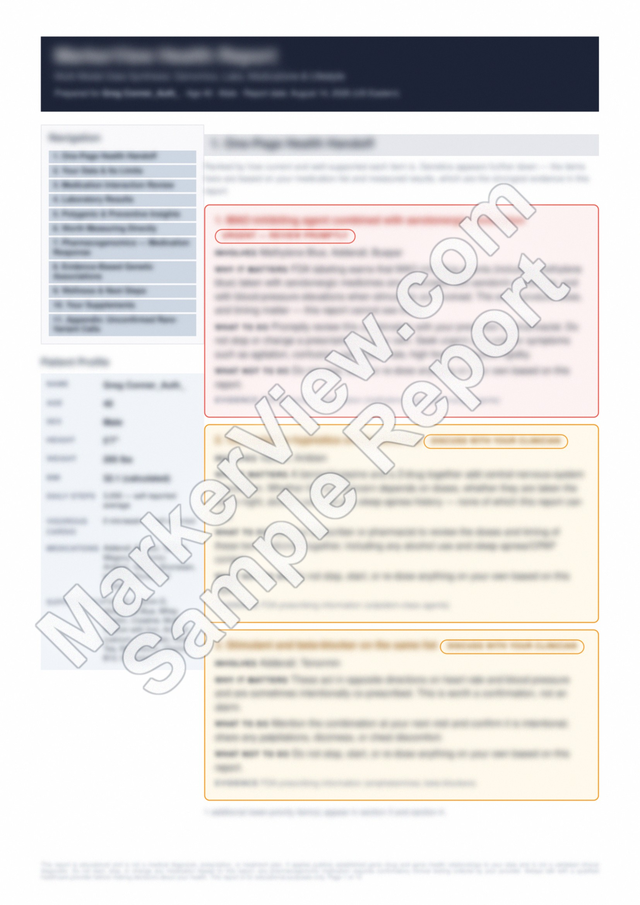
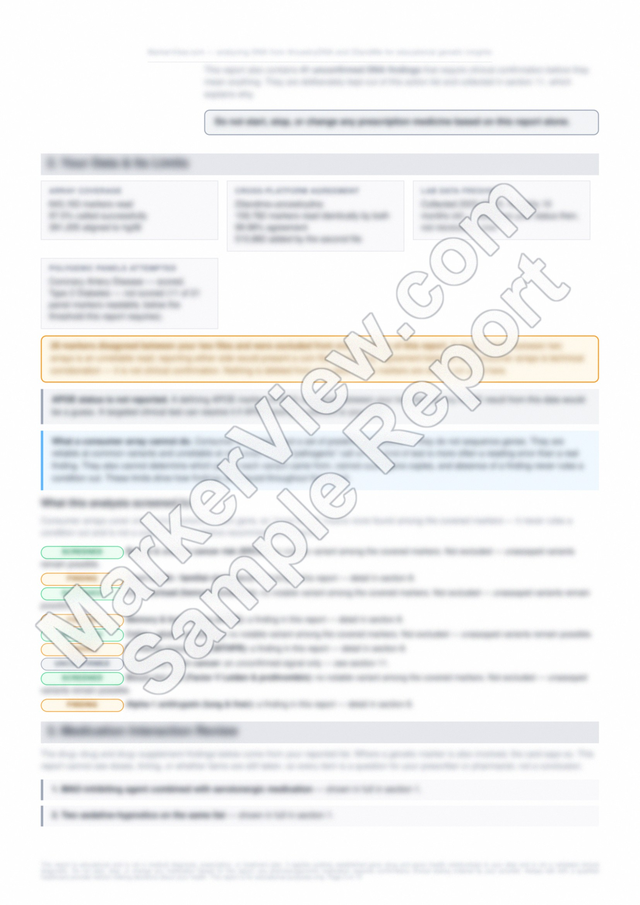
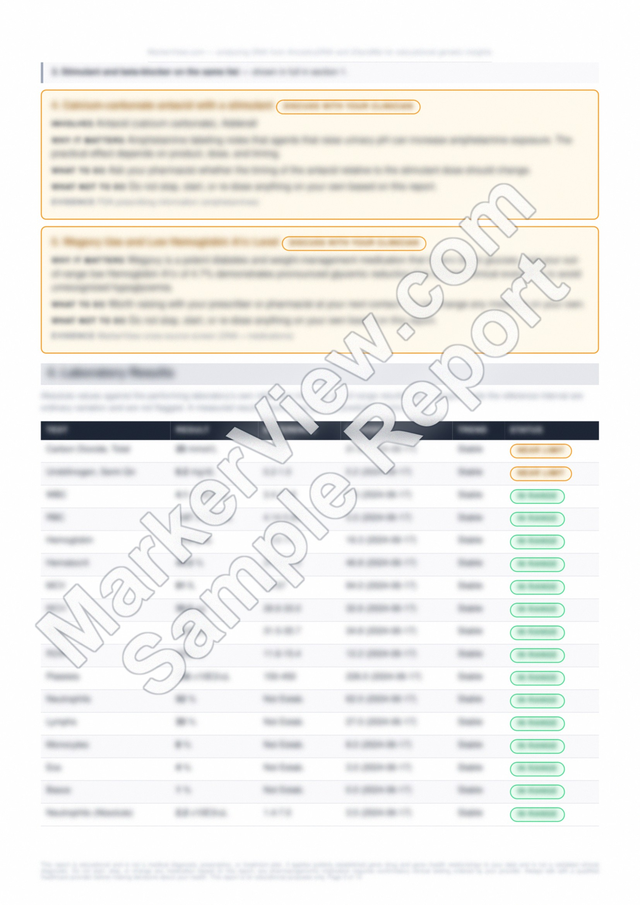
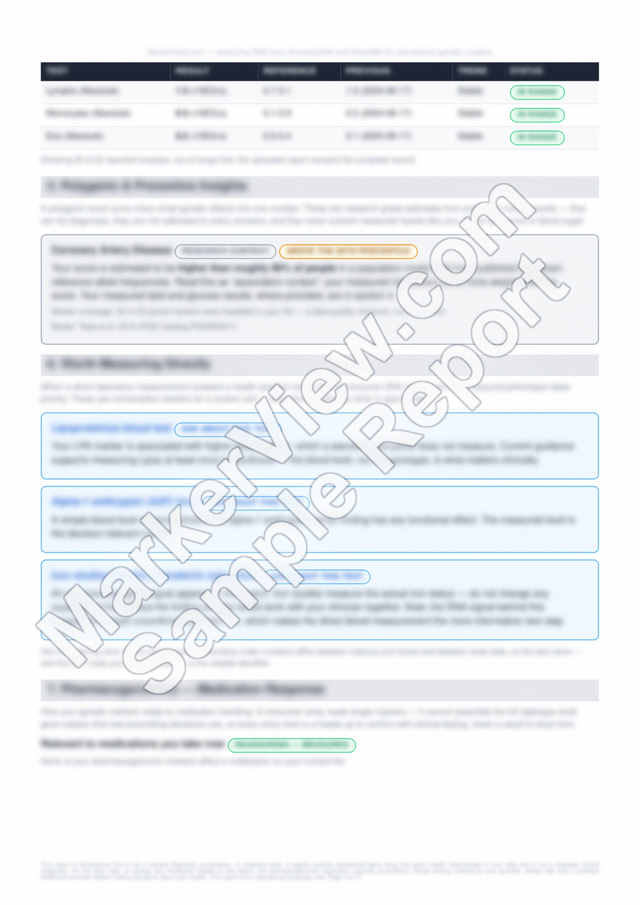
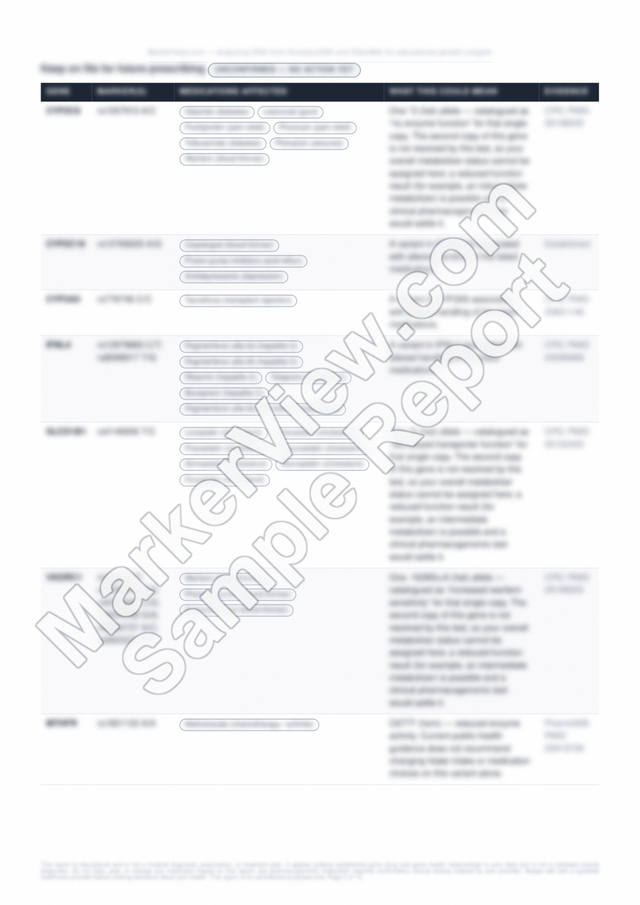
This is what a Comprehensive report looks like: the sections, the layout, the evidence labels and the questions it hands to a clinician. Every name, value and finding is blurred on purpose, so what you see is the shape of the report, not anyone's results.
Text blurred on purpose · The founder's own, complete report is free by email
Want to read a real one?
The founder's own report is a short email away.
MarkerView has a named founder, Greg Conner, and his complete, unblurred report is the real sample: email him and he will send it, free. The founder page says who he is, why he built MarkerView, and how to ask. Meet the founder and request his report →
The inputs
What goes into a report
A Comprehensive order reviews four things together. The profile column on page 1 is where they are listed back to the customer.
Raw DNA file
The AncestryDNA or 23andMe file the customer already has. When both are supplied, Comprehensive merges them and reports how well the two agree.
Profile
Age, sex, height, weight and typical daily activity, plus any free-text context the customer chooses to add, such as family history.
Medications and supplements
The list the customer types in. It drives the interaction review, the pharmacogenomic table and the supplements section.
Lab panel (optional)
A recent lab report as a PDF from any laboratory. The report reads the analytes, compares them with prior values where they are present, and dates them.
Table of contents
The 11 sections of a Comprehensive report
Sections with nothing to say are dropped and the rest are renumbered, so two reports rarely have the same table of contents. This one kept all 11.
- One-Page Health Handoff
- Your Data & Its Limits
- Medication Interaction Review
- Laboratory Results
- Polygenic & Preventive Insights
- Worth Measuring Directly
- Pharmacogenomics — Medication Response
- Evidence-Based Genetic Associations
- Wellness & Next Steps
- Your Supplements
- Appendix: Unconfirmed Rare-Variant Calls
Limits
What a report like this cannot tell you
- Consumer arrays are not sequencing. An AncestryDNA or 23andMe file covers a fixed set of markers, and a rare disease-causing variant it reports can be a false positive. MarkerView keeps such calls off the front page and says when confirmatory testing is the next step.
- Coverage is uneven. The report shows how many of a gene's known markers the file covered; a gene with two of fourteen markers covered is mostly unread.
- Polygenic scores are estimates, built from published panels and calibrated to a reference population. They rank likelihood; they do not diagnose.
- Medication and supplement notes come from labeling and monographs, not from a clinician who knows the person. They are conversation starters for a pharmacist or physician, never instructions.
- MarkerView is informational. It does not diagnose, treat or prevent any condition. Every finding is written to be discussed with a qualified clinician before anything changes.
Your file. Your medications. One report to bring to your next appointment.
Upload the raw file you already have; most reports are ready within a couple of hours.